Xp Sata Driver Cd
Table of Contents
If you are goinig to install WinXp on a Laptop, the best way is to embed the Sata driver in your Windows Cd. To solve this problem, you can use nLite to embed the needed Sata driver into your WinXP Cd. Creating custom CD; 1. Download the SATA driver of your motherboard. To download the SATA driver, go to the website of the manufacturer of your motherboard. Select Windows XP 32-bit (or 64-bit Windows XP if this is the case. But this version is very rare) as the operating system and download the driver 'SATA', 'HDD' or Hard Drive. Stupid Thinkpad X200 keeps BSODing when I try to install XP SP3 via the CD drive so I had to do it thru USB. USB install wont' recognize the SATA HDD so I had to change the mode in bios to COMPATIBILITY.
Introduction
After a version of Windows is released, over time bugs are found or new enhancements are added by Microsoft. In order to fix these bugs and add these new enhancements, Microsoft will occassionally release a large update called a Windows service pack that contains all of bug fixes, enhancements, and new features created since Windows was released. Unfortunately, CDs that you have for Windows usually do not have these newer Service Packs already installed. This means that if you ever need to reinstall Windows with your CD, you will also have to deal with the timely task of reinstalling the service packs. To make matters worse, some of the fixes in these service packs are security related, and by not having them installed, your computer may be at risk from viruses or vulnerable to hackers. Therefore, not having these service packs installed after you install Windows could open yourself up to big security risks.
In order to resolve these types of issues it is possible to integrate the newer service packs over an an older copy of the Windows installation files. This allows you to install Windows with the service pack already installed so that you do not have to install them after the installation process. This process of integrating the newer service packs with older installation files is called slipstreaming. The goal of this tutorial is to walk you through creating a slipstreamed Windows installation CD or DVD that already contains Windows XP Service Pack 3. That way if you install Windows using this CD/DVD, your installation will already have these large updates installed, your computer will not be in as much danger, and you can just focus on installing the latest updates and the applications that you want on your computer.
Different chipset => different AHCI driver UPDATE 3: If you try to install Windows XP on a newer laptop, sometimes Windows XP failed to detect the hard drive, especially if your laptop using SATA AHCI mode. That's why you need to slipstream your SATA AHCI drivers into a Windows XP installation CD using nLite. Click on the following links for the driver SATA Driver Intel package readme info./SATA_Intel_v7.0.0.1020/Readme.txt This package supports the following. How do I install Xp on Sata drive without a floppy drive? Nooby snack Dec 1, 2007, 8:26 PM. The best solution is to integrate your SATA drivers into your XP installation CD.
First Steps
Before we can start the process of creating Windows install disc, we first need to gather some software. Below is a list of software that you will need to download and install, as well as CDs that you should have on hand in order to continue.
- An existing copy of Windows XP home, Professional, or Media Center. Unfortunately, for this step you can not use an OEM CD provided by your computer manufacturer (Dell, HP, etc).
- Nero Burning Rom or nLite if you do not have NERO
- A copy of your SATA drivers from your motherboard Web site if you have a SATA HDD that requires special drivers.
- A blank writable CD or DVD and a CD/DVD burner.
Once you have made sure you have all the software or media listed above, you should create a folder that will be used to store the files that will be written to the installation disc. For this tutorial, we suggest you create a folder on your C: drive labeled XPCD. Once the folder is created, please copy the entire contents of your XP CD to this folder.
Extracting the boot image
After you have completed copying your windows XP CD you will need to create a boot image by extracting it from your existing XP CD. To do this, have your XP CD inserted in your computer and start ISOBuster. When the program starts you will see a screen similar to the following. If you do not, change the selected drive so that it is pointing to the drive that contains your Windows XP CD.
In the left hand pane you should select Bootable Disc. Click once on this Bootable Disc option, so it is selected, and you will now see a file called Microsoft Corporation.img in the right hand panel as shown in the image below.
Now right-click on the MICROSOFT CORPORATION.img file and select the extract MICROSOFT CORPORATION.img option as shown in the image below.
When it prompts you for the location where you would like to extract the file, save it to the folder you copied the contents of your XP CD earlier in the guide. If you are following the guide step-by-step, this folder will be C:XPCD.
How to slipstream Windows Service Pack 3
Now that we have extracted the boot image we need to slipstream the service pack over the Windows files you previously copied into the C:XPCD folder. Please make sure you have downloaded the network installation version Windows XP Service Pack 3 before continuing as we will need it during this step. When downloading the service pack, please download the files to the root directory of your C: drive.
Once the service pack is downloaded, you can slipstream the service pack using two methods. The first method is to use the command line and the second is to use the nLite program. The command line method will probably be a bit easier if you are comfortable with the Windows command prompt. Otherwise, use the nLite method described below.
Using the Command Line to slipstream the service pack:
Click on the Start Menu and then select Run. Then type command into the Open: field. Finally, click on the OK button. You will now be at a command prompt where you should type the following bolded lines. After each line, press enter on your keyboard as shown in the figure below.
CD
C:WindowsXP-KB936929-SP3-x86-ENU.exe /integrate:C:XPCD
If you are using an OEM Windows XP CD you will receive the following error. This error means that you cannot use this type of CD to create a slipstreamed installation and will not be able to continue with this tutorial.
Now that you are done slipstreaming the service pack using the command line. You should now skip to the section detailing how to slipstream your SATA hard drive drivers. If you are not using a SATA drive you can skip ahead to learn how to burn the DVD.
Using nLite to slipstream the service pack:
Download nLite and install the program. When the program starts, click on the Next button, and then at the next screen, select the Browse button to see a screen similar to the one below.
Now select your Windows installation folder that we created at C:XPCD and then click on the OK button. nLite will scan the directory and identify any previously installed Service Packs. When it has finished, click on the Next button. You will now be on a screen asking if there are any presets that you would like to use. Just click on the Next button again to continue.
You will now be on the Task Selection screen. Simply click once on the Service Pack button so that the circle becomes green as shown in the image below.
Now that it is selected, click on the Next button. You will now be prompted for the location of your service pack installation file that you downloaded earlier as shown in the image below.
Browse to the service pack file and select it. Then click on the Open button. file. Once you click on the open button, nLite will automatically slipstream the service pack into your C:XPCD folder. When it has finished, click on the Next button, and then at the next screen, click on the Finish button to close the program.
Enter 'Y' and hit Enter key. How to Install Alcatel Ideal 4060A ADB and Fastboot Drivers: Step 1: Download the 15 Seconds ADB installer on your PC. If it is in the.zip archive then extract it to obtain the.exe file. Step 2: Right-click on the file and Run as administrator. Step 3: It should ask, whether you want to install ADB and Fastboot Driver on PC. Driver alcatel x070s windows 8.
You should now continue to the section detailing how to slipstream your SATA hard drive drivers. If you are not using a SATA drive you can skip ahead to learn how to burn the DVD.
How To slipstream SATA Drivers Using nLite
If you have not already installed nLite, you will need to download and install the program first. Next, you will need to download your SATA drivers from your motherboard or computer manufacture's web site. In our example, I will be using VIA raid drivers from Biostar. Once the SATA drivers have been downloaded, you should extract them to a folder on your hard drive. In our example, we have extracted the drivers into the C:SATA Driver folder.
Now that everything is prepared you should start the nLite program. When the program starts, click on the Next button, and then at the next screen, select the Browse button to see a screen similar to the one below.
Now select your Windows installation folder that we created at C:XPCD and then click on the OK button. nLite will scan the directory and identify any previously installed service packs. When it has finished, click on the Next button. You will now be on a screen asking if there are any presets that you would like to use. Just click on the Next button again to continue.
You will now be on the Task Selection screen. Simply click once on the Drivers button so that the circle becomes green as shown in the image below.
After selecting Drivers, you should click on the Next button. You will now be at the Drivers screen. You should now click on the Insert button and then select the Multiple driver folder option so you can include all of the drivers for your specific operating system.
You will now be prompted for the folder where your extracted drivers are. You now want to browse to this folder, and when there, locate the correct folder for your Operating system. In our case it is the x86 directory since I am using 32bit Windows XP Pro.
You should now select the folder, and then press the OK button. nLite will now automatically install the drivers contained in both subdirectories. You will now see a screen showing the available drivers found in these folders. You should click the All button to select all drivers for your system and then press the OK button.
NOTE: If there are drivers for other versions of windows, for example Vista or 64 bit drivers, do not install them as it will cause file load errors. If you do select them, nLite will notify you of the problem.
When done selecting the correct drivers, click on the OK button.
A new screen will appear asking what driver mode you would like to select. At this screen, you should select the Textmode Driver as shown in the image below.
If multiple are listed in the Textmode integration options box, select the appropriate driver for your operating system. The OK button will now become available and you should click on it. Do this same routine for for each and every driver that you are installing.
After selecting Textmode Driver you will be at a page listing all the drivers that will be installed. You should click on the Next button and then click on the OK button when it asks if you want to start the process. Your SATA drivers will now be integrated into your Windows files folder. When the process has finished, click on the Next button and then the Finish button.
You are now ready to burn the Windows files to your a bootable DVD. If you will be using Nero to create this DVD, then you can continue to the next section. Otherwise, you can skip ahead to instructions on how to use the free nLite utility to create your DVD.
Burn a bootable CD or DVD Using Nero
Please note that older versions of NERO may not use the same steps as what are outlined in this guide. These steps were created for use with Nero 7 and above.
If you own Nero, then start the Nero Burning ROM program. Once started, if you do not see an option labeled Make Bootable DVD, as shown in the image below, you will need to enable the advanced user settings.
To start, select the Make Bootable DVD option. On the next screen you will be asked to select a Boot image. You should browse to the folder where you saved the Microsoft Boot image that you extracted using Isobuster in previous steps and select it. Please note, that by default Nero will be looking for a file with a .IMA extension, so you will need to change the file type to All Files (*.*) in order to select the MICROSOFT CORPORATION.img boot image. This is shown in the figure below.
You should now click on the Boot tab and put a checkmark in Enable expert settings. Then change Kind of Emulation to No Emulation. Then change the Number of loaded sectors to 4. When done your screen should look similar to the image below.
Under the ISO tab, you should not have to change any settings. Just click on the tab to make sure it is configured as shown in the image above. If you have an older version of Nero you will not have the option Do not add the ';1' ISO file version extension under the Relax restrictions category.
Now click on the Label tab. We recommend changing the labels on your completed CD or DVD so that they match your Windows CD. To do that Select Manual and then enter the labels into the ISO 9660 and Joilet fields. For Windows XP Pro you should enter WXPCCP_EN. For Windows XP Home you should enter WXHCCP_EN. An example of this is shown in the image below.
Now click on the New button to open the file browser as shown in the image below.
In the right hand pane you will navigate to your slipstreamed location, C:XPCD, and left-click once on it to select it. Then select all of the files in the right-hand pane and drag them into the left-hand pane. When this is completed, click on the Burn button in the top menu bar. Nero will create the bootable CD for you and you will now have a Slipstreamed Windows XP SP3 CD or DVD!
Burn a bootable CD or DVD using nLite
If you have not already installed nLite, you will need to download and install the program first and then start it.When the program starts, click on the Next button, and then at the next screen, select the Browse button to see a screen similar to the one below.
Now select your Windows installation folder that we created at C:XPCD and then click on the OK button. nLite will scan the directory and identify any previously installed Service Packs. When it has finished, click on the Next button. You will now be on a screen asking if there are any presets that you would like to use. Just click on the Next button again to continue.
You will now be on the Task Selection screen.
On this screen select the Bootable ISO option as shown in the image above and then click on the Next button.You will now be at the Bootable ISO screen that will look similar to the image below.
If the screen above does not look exactly like what you see on your computer, do not be concerned as we need to make some changes first. First change the Mode option to Direct Burn. Then, for the Label field we recommend using the same label that was on your original Windows CD. For Windows XP Pro you should enter WXPCCP_EN into the Label field. For Windows XP Home you should enter WXHCCP_EN into the label field. Next, make sure your CD/DVD burner is selected in the Device menu. Last, but not least, change the Burn Speed to 8X in order to get a reliable burn.
When you have finished configuring these settings, we need to specify our boot image. To do that, change Boot Sector to custom and a window will open asking you to locate your boot sector. You should browse to the folder where you saved the Microsoft Boot image that you extracted using Isobuster in previous steps and select it. Please note, that by default nLite will be looking for .bin or .dat files, so you will need to change Files of type to All Files. Once you do that you will be able to select the MICROSOFT CORPORATION.img boot image as shown in the image below.
Once you have changed all of your settings and selected your boot image, we are ready to create the Windows installation media. To start this process, click on the Burn button. A confirmation prompt will appear asking if you are sure you want to burn the content to the media. You should click on the Yes button to start the process. nLite will now start preparing the content that will be copied to your media. This may take some time, so please be patient. When it has finished preparing the files, nLite will start writing them to your media as shown in the image below.
Please be patient while the files are written to your media. When it has finished, you will see a message stating the written files were verified successfully. You can then click on the Next button and then click on the Finish button to close nLite.
You now have a Slipstreamed SP3 CD or DVD!
Conclusion
Now that you have learned how to make a bootable Windows installation disc you can make an install or reinstall process much quicker and secure. Using a disk like this you can now install Windows XP and be at a high patch level so that your freshly installed operating system is less vulnerable to malware and hackers. This also enables you to go to locations where there is not a lot of bandwidth and install Windows with all of the latest service packs installed so you do not have to wait for a long time while the service pack downloads. If you have any questions regarding this process, or tutorial, please feel free to ask us in the Windows XP forum.
Although Windows XP is no longer officially supported by Microsoft it’s still a hugely popular operating system. Now is obviously a good time for people to move to Windows 7 or 8 if possible, but not everybody can or wants to completely leave XP for various reasons. Time moves on though, and things like software compatibility and especially driver support will eventually become more of a problem if you use newer hardware for your Windows XP equipped computer.
One area where Windows Vista, 7 and 8 have greatly improved over XP is driver support out of the box which is partly why the XP install disc is a CD and the others are a DVD. This is obviously a great help because having the video, motherboard, drive controller, sound and networking hardware detected and the drivers installed automatically can save time and effort, especially if you can’t access the internet to download any drivers because your network adapter has no driver installed.
It can become quite tough finding all the right drivers when you reinstall Windows, some may come from the manufacturer website, others could be for unknown or discontinued hardware. DriverPacks is a set of hundreds of drivers which you integrate into a Windows XP install disc, and then while Windows is installing, any needed hardware drivers contained in those packs are automatically installed as well. It’s a nice solution when you have to do nothing but wait a few extra minutes instead of playing detective or using another computer to get your drivers for a clean install.
Xp Cd'sine Sata Driver Entegre Etme
DriverPacks also produce packages for Vista and Windows 7 but they are less useful because the DriverPacks system has never been updated to support them. There is another method for Vista and 7 whereby you can create a DVD/USB to install drivers after the operating system has been installed.Here we show you how to create a Windows XP setup disc which will install most, if not all of your important drivers. You will need a Windows XP install CD. Note you can create the disc using a Windows vista/7/8/8.1 system but it will obviously only install Windows XP.
Windows Xp Sata Drivers
1. Insert your Windows XP install CD and copy all files/folders to a folder on your computer, for example C:WindowsXP.
2. Download DriverPacks Base and place the self-extracting executable file into a new folder, e.g. C:DriverPacks. Execute the DriverPacks Base file and let it extract its contents.
3. Download the Driverpacks you want for XP. There are several available but we would advise you just stick to the most critical drivers to get your computer running properly, namely Chipset, Graphics, LAN, WLAN, Sound and Mass Storage. Packs like Webcam or Bluetooth are less important and 3rd party meaning they are not officially tested and could cause problems.
An important note is these days the DriverPacks are only distributed as torrents so you will need either a torrent client or use something like Bitlet which allows you download torrents through your web browser. Packs are always well seeded and should download quickly.
If you want to reduce space and only include one set of drivers for your own PC for instance, download the Graphics pack which contains the required drivers. For example, Graphics A contains most of the nVidia and AMD/ATI drivers, Graphics B includes the Intel video drivers and etc. A similar thing applies to Sound packs.
4. Copy the downloaded packs to C:DriverPacksDriverPacks or the folder you created in step #2. Do not unpack them as they are 7z archives.
5. Run DPs_BASE.exe from the C:DriverPacks folder, expand the Settings tree and click on Location. At the page asking you to select location of platform, make sure “disc” is selected, click Browse and locate the folder you copied the Windows XP CD contents to in step #1. It will then identify the operating system inside the folder.
6. Go to Settings > DriverPacks and select the packs that you want to integrate and click Next. The Mass storage text mode at the bottom is useful if you use a SATA or RAID controller on your computer, read our article on SATA/RAID in XP to find out more.
7. In the Settings > Driverpacks method window make sure “method 2” is selected. Click Overview to review your settings or simply click the Slipstream! button to begin the process, it should take no more than a few minutes.
8. There are a couple more steps to go through to get your XP + drivers disc to actually install, first you need to create an ISO file and then burn it to disc or USB. To create the ISO download RVM Integrator which is a tool a little similar to nLite.
9. Run the executable inside the archive and go to the Make ISO tab, click the button to browse to the location which holds the XP folder from step #1, then click the button to give a filename and folder for the new ISO file. Click Make.
10. The last step is to either burn the ISO image to DVD or write it to USB. We have a list of 10 tools that can burn ISO images to disc or alternatively for a bit more speed during install, write the Windows ISO to USB flash drive using one of the 10 Windows to USB tools in our article.
Now all you have to do is boot your computer to USB or CD/DVD as you normally would to install Windows and go through the setup and install process. Before you reach the blue XP setup interface, the Driverpacks will begin extracting themselves to the hard drive ready for installation later in the process.
If all goes well your Windows XP will be installed and all the important drivers will already be installed meaning you can get on and do other things without the hassle of searching for and installing compatible drivers.
Note: There are many other extras you can add into an XP installation disc with slipstreaming tools such as nLite, things like individual drivers, service packs and hotfixes etc. If you are doing this as well you need to make sure the Driverpacks are added last, so use nLite or RVM Integrator first, then use the Driverpacks in this guide after.
You might also like:
3 Apps to Create a USB or DVD with All Hardware Device Drivers for Windows XP, Vista and 74 Ways to Detect and Install Network Drivers Offline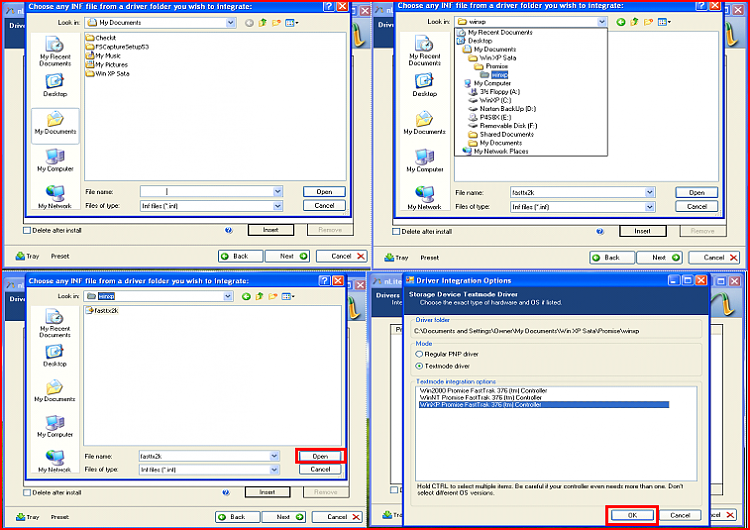 Create An Integrated Up To Date Windows 7 Install Disc2 Ways to Integrate Floppy SATA RAID Driver into Windows XP CD5 Tools to Backup and Restore your Windows Drivers
Perfect, this will come in handy.
STUMBLED!
Why thanks a lot for the tip. I made a “All you can eat XP DVD” for work and it’s already come in handy in installing missing drivers for a network controller (so much easier then the old route of guess and check)
Much appreciated. You’ve won yourself another frequent. ;)
Wow, thank you very, very much!!!
Thanxs a lot.I rebuild computers for the Computers for Kids project here in SE Ky and I run into all sorts of hardware.This helps a lot.
i’ve done it!
thanks ray!
keep it up!!!
super blog!!!
Thanks raymond, bout this article. It helps a lot for me being a technician
thank u very much. this will help me a lot .

if this works you’ll have made my workdays much easier, knowing the fact that i do work as a IT&C Technical support specialist, i deal with system reinstalls all day, and this may be very helpful!
Thanks in advance!
very informative!! thanks a lot
Microsoft Windows Xp Sata Drivers
sweet! Nice info, Raymond.